
TL;DR
Most people do not search for a lawyer by name. They search on Google when a legal problem appears. This is where SEO becomes critical for law firms.
SEO helps a law firm show up in those searches. It is how a law firm website appears in Google when someone looks for legal help. SEO uses content, website structure, and local signals to bring the right visitors to your site. When done correctly, SEO builds trust, authority, and consistent leads over time.
Choosing the best SEO company for lawyers is not about quick rankings. Law firm SEO is competitive and based on trust. A good SEO partner focuses on long-term visibility, not shortcuts.
This guide explains how SEO for law firms actually works, why it matters, and how to evaluate an SEO company for lawyers with clarity and confidence.
What the Best SEO Company for Lawyers Actually Does
The best SEO company for lawyers does not rely on random tactics. It does not chase quick wins. It builds a clear SEO system that improves visibility, trust, and lead quality over time.
SEO for lawyers is different from general SEO
Legal SEO follows strict quality rules. Legal services affect people’s lives and decisions. Because of this, Google expects higher accuracy and trust from law firm websites.
Thin content does not work well. Exaggerated claims also fail. Pages without clear authorship often struggle in search results.
Google explains these rules in its Search Quality Evaluator Guidelines. These guidelines focus on trust, expertise, and helpful content for sensitive topics.A strong law firm SEO strategy follows these standards. It does not use generic SEO methods.
Why legal SEO requires intent alignment
People search for lawyers because they have a real problem. They are not browsing for fun. Good SEO matches content to what users need at each step.
A reliable SEO partner connects blog content, service pages, and local visibility into one clear path. This helps users move forward without pressure.
For a practical example, see our SEO for law firms service page.
Why SEO Matters More Than Ever for Law Firms
A law firm can be well known offline and still lose clients online. If your firm does not appear in search results, people will not find you. SEO helps your firm show up when someone searches for legal help.
How potential clients search for legal services today
Most people start their search on Google. They scan the results. They compare law firms. They read short descriptions before clicking. If a website looks unclear or untrustworthy, they move on.
Research on search behavior shows how people use Google when looking for services. Most users scan the top results first and choose websites that look clear and trustworthy. This matters even more for professional services like law firms, where people want reliable help. Because of this, users often trust organic results more than ads when making serious decisions.
Studies on click-through rate show what percentage of people actually click a result after seeing it. Results that appear higher on the page receive most of the clicks. Listings that appear lower often get ignored, even if they are relevant.
Why organic search brings better legal leads
Paid ads can bring traffic fast, but organic search brings users who are more careful. These users read content. They compare options. They build trust before contacting a firm.
SEO supports this process by educating users instead of interrupting them. This is why organic traffic often leads to higher-quality inquiries and better long-term results for law firms.
How Google Evaluates and Ranks Law Firm Websites
SEO is not guesswork. Google uses clear rules to decide which law firm websites appear in search results. These rules focus on relevance, authority, and user experience.
Relevance, authority, and experience signals
Relevance means your page clearly matches what someone is searching for. Authority builds when a website covers a topic in depth and earns trust through credible references and quality backlinks. Experience is about how easy the site is to use, read, and navigate.
Google explains how these factors work together in its SEO Starter Guide.
Engagement and intent satisfaction
Google also looks at how people behave after clicking a result. Pages that answer questions clearly and guide users step by step tend to perform better over time. Pages that confuse users or fail to solve the problem often lose visibility.
Mobile behavior matters even more for law firms. Many legal searches happen on phones, where speed, clarity, and layout strongly affect user decisions.
Core SEO Ranking Factors
A strong law firm SEO strategy does not rely on one tactic. It works when several ranking factors support each other in a clear and consistent way.
Content quality and topical authority
Good legal content answers real questions in a clear and accurate way. It helps users understand their problem and possible next steps. Topical authority grows when a website covers a subject fully over time, not when it publishes scattered articles with no clear focus.
You can see how this approach works in our law firm marketing strategy guide.
Backlinks and authority building
Backlinks are still an important ranking signal, but only when they come from trusted and relevant sources. For law firms, a few strong links matter more than many weak ones. Ethical link building focuses on context, reputation, and long-term trust.
Ahrefs explains what makes a high-quality backlink and why quality matters more than volume.
Technical SEO foundations
Technical SEO helps search engines find, read, and understand your website. It covers things like site structure, indexing, and performance. When technical SEO is weak, even strong content can struggle to rank.
A clear overview of technical SEO fundamentals explains how this foundation supports long-term visibility.
Page experience and usability
User experience is now a direct ranking factor. Google favors websites that are easy to use, easy to read, and fast to load. Clear navigation and mobile-friendly design also help users stay engaged.
Google outlines these expectations in its Page Experience guidance.
Technical SEO Standards the Best SEO Companies Follow
Technical SEO is not about code for the sake of code. It is about making sure a law firm website works smoothly for both search engines and real people. When technical SEO is done right, it improves visibility, trust, and conversions at the same time.
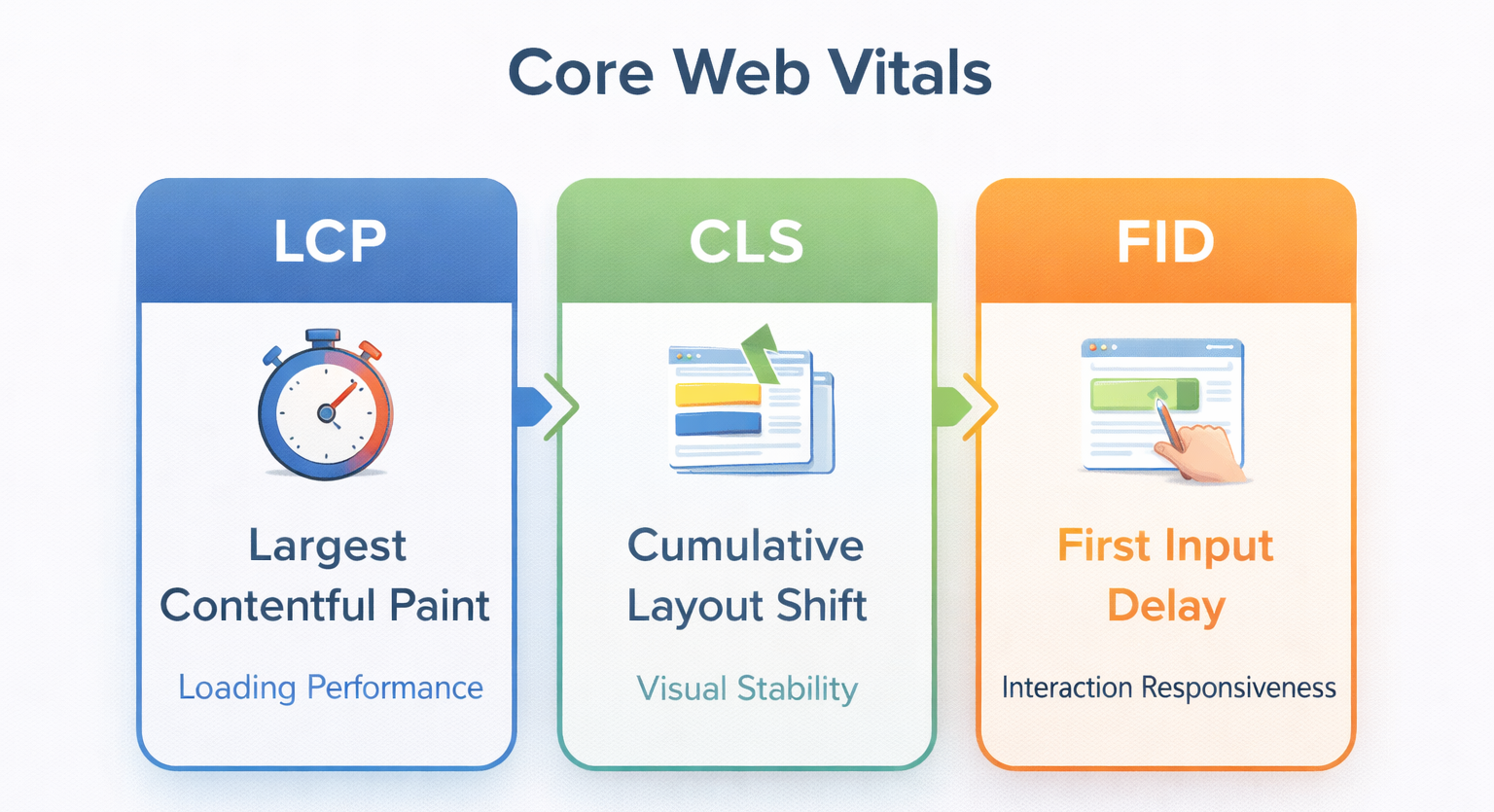
Core Web Vitals explained in simple terms
Google uses a set of performance signals called Core Web Vitals to measure real user experience. These signals help Google understand whether a website feels fast, stable, and easy to use.
Largest Contentful Paint (LCP) measures how fast the main content loads on a page. If a law firm website loads slowly, users often leave before reading anything. Slow pages also struggle to rank well.
Cumulative Layout Shift (CLS) measures how much a page moves while loading. Pages that shift suddenly can confuse users and create a poor experience. This is common on poorly built law firm websites.
First Input Delay (FID) measures how quickly a page responds when someone clicks or taps. If a site feels unresponsive, users lose trust and often exit.
Law firm websites that perform well on these metrics tend to keep users engaged longer and convert better, which supports both rankings and lead generation.
Indexing, crawlability, and site hygiene
Search engines must be able to find and understand your website before it can rank. Clean site structure helps Google see which pages matter most. A strong SEO partner manages indexing carefully, prevents duplicate pages, and ensures service pages receive priority.
When technical hygiene is ignored, even good content can fail to perform.
Local SEO and Google Maps Optimization for Law Firms
For most law firms, local visibility drives real business. When people need legal help, they usually search for a lawyer near them. Convenience, location, and availability play a major role in their decision.
Why local SEO matters for law firms
Most legal searches include a location, even when users do not type one. Google uses location signals to show nearby firms in search results and map listings. This is why law firms often compete locally, not nationally.
Local SEO helps a law firm appear in these location-based results. It places your firm in Google Maps and local listings when someone searches for legal services nearby. These searches often lead directly to phone calls and consultation requests.
For a detailed explanation of this process, see our guide on local SEO for lawyers.
Reviews and local trust signals
Reviews play a strong role in local rankings and client trust. People compare ratings, read feedback, and look for consistent business information before contacting a firm.
A structured review strategy, accurate business details, and consistent citations across directories help build local credibility. These signals tell Google and potential clients that your firm is active, reliable, and trustworthy.
Keyword Research Strategy Used by SEO Companies
Keyword research is not about chasing big numbers. It is about understanding what people are really looking for when they search for a lawyer.
Informational vs commercial keywords
Some searches are made by people who are still learning. These are informational keywords. They help users understand a legal issue and build trust with a law firm.
Other searches are made by people who are ready to contact a lawyer. These are commercial keywords. They usually lead to calls, form submissions, or consultation requests.
A strong SEO strategy uses both types. Informational content educates users. Commercial pages convert them when they are ready.
Mapping keywords to pages without confusion
Each keyword must match the right type of page. Service pages should focus on legal services and contact intent. Blog content should support authority and answer questions without competing with service pages.
When keywords are mapped poorly, pages compete with each other. This often causes rankings to move up and down. A good SEO company avoids this by planning page intent first.
Using real questions to guide content
Tools like AnswerThePublic help reveal the real questions people ask before hiring a lawyer. These questions guide blog topics and help law firms create content that matches real search intent instead of guessing.
How SEO Strategy Differs Across Law Practice Areas
The basics of SEO stay the same, but how they are applied depends on the type of law firm. Different practice areas attract different search behavior, competition levels, and client expectations.
Personal injury law firms
Personal injury SEO is one of the most competitive areas in legal search. Firms compete heavily in local results and organic listings. This requires strong authority signals, detailed content, and consistent local optimization to stand out.
Family and divorce lawyers
Family law searches are often emotional and sensitive. People look for clarity, trust, and reassurance. SEO for family lawyers focuses on clear language, strong credibility signals, and content that feels supportive rather than aggressive.
Immigration law firms
Immigration searches often involve urgency and complex eligibility questions. SEO for immigration lawyers depends on clear explanations, accurate information, and content that builds confidence quickly.
Business and corporate law firms
Business-related legal searches are more research-driven. Clients compare firms carefully before reaching out. SEO for these firms focuses on authority, professional positioning, and content that demonstrates expertise and experience.
SEO in the Age of AI Search
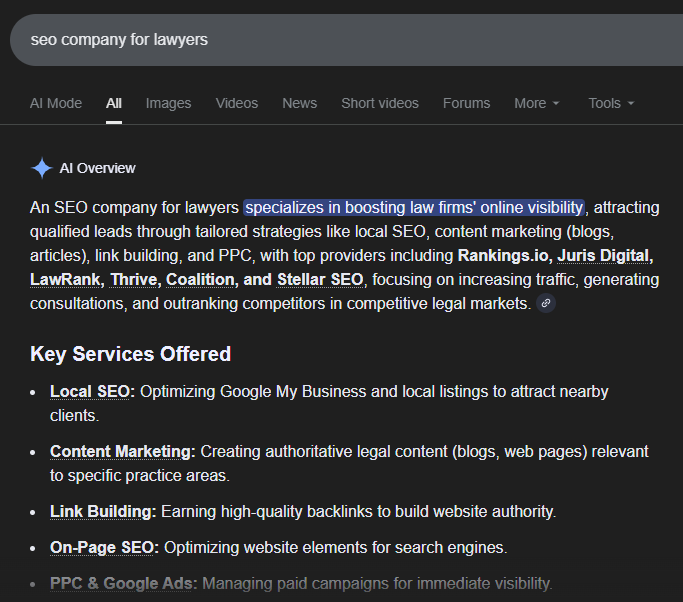
AI-powered search tools summarize content instead of just listing links. To appear in these results, content must be clear, structured, and trustworthy.
AI systems look for pages that explain topics step by step, use simple headings, and support claims with reliable sources. Pages that answer real questions directly are more likely to be used in AI summaries.
Even as search evolves, Google continues to rely on proven SEO principles. These include clear content structure, accurate information, and a strong focus on user intent. AI does not replace SEO. It rewards pages that follow SEO best practices consistently.
For law firms, this means content must be written for people first, while still being easy for search systems to understand and summarize.
Measuring SEO Results for Law Firms
SEO results should be measured using realistic and business-focused metrics. Rankings alone do not show whether SEO is working.
Metrics that matter
Organic impressions show how often your law firm appears in search. Keyword visibility shows how consistently your pages rank. Traffic quality reveals whether visitors are relevant. Lead conversions show whether SEO is producing real inquiries.
When these metrics improve together, SEO is delivering real business value, not just visibility.
Common Mistakes When Hiring an SEO Company for Lawyers
Many law firms hire SEO companies without knowing what to look for. This often leads to wasted time, money, and missed opportunities.
Guaranteed rankings
No SEO company can guarantee rankings. Google controls search results, not agencies. Promises of instant results or page-one guarantees are a common warning sign. These tactics often rely on shortcuts that fail over time.
Google explains this clearly in its SEO Starter Guide, which emphasizes long-term quality over quick wins.
Generic SEO strategies
Legal SEO is not the same as SEO for other industries. Law firms operate under higher trust standards and stricter expectations. Generic SEO strategies often ignore search intent, credibility, and compliance, which can limit long-term results.
Lack of transparency
A reliable SEO company should explain what it is doing and why. If reports are unclear or progress cannot be explained in simple terms, results are usually inconsistent. Transparency is a key sign of real expertise.
How to Choose the Best SEO Company for Lawyers
Choosing the right SEO partner starts with asking practical questions, not listening to sales promises.
Questions law firms should ask
Ask whether the company has experience working with law firms. Ask how they handle content strategy, technical SEO, and local visibility. Ask how results are measured and reported. Clear answers matter more than impressive language.
What separates real expertise from marketing claims
Real SEO expertise is shown through education, structure, and realistic expectations. Strong SEO companies focus on steady growth, clear processes, and long-term visibility. They do not rely on hype or aggressive sales tactics.
To see how this approach works in practice, explore our SEO for law firms services or visit Better Business for Lawyers.
FAQ’s
- What is SEO for law firms?
SEO for law firms is the process of improving a law firm website so it appears in Google search results when people look for legal help. It includes content, technical setup, and local visibility. The goal is to help the right clients find your firm at the right time. - Why do law firms need SEO?
Most people search online when they need a lawyer. If a law firm does not appear in search results, potential clients will choose a competitor instead. SEO helps law firms stay visible, build trust, and generate consistent inquiries over time. - What does law firm SEO include?
Law firm SEO includes keyword research, content creation, technical optimization, and local SEO. It also focuses on website performance, clear structure, and trust signals. Together, these elements help improve rankings and user experience. - Why is local SEO important for law firms
Most legal searches are location-based. People usually look for lawyers near them for convenience and accessibility. Local SEO helps law firms appear in Google Maps and local search results, which often leads directly to calls and consultation requests. - Why does SEO for personal injury lawyers matter?
Personal injury law is highly competitive. Many firms target the same searches in the same locations. SEO helps personal injury lawyers stand out by building authority, improving local visibility, and attracting clients who are actively looking for legal representation.
Final Thoughts
The best SEO company for lawyers focuses on long-term results. It uses clear strategy, strong technical work, and trust. It does not rely on short-term ranking tricks. When law firms understand how SEO for law firms works, they can choose better providers. They avoid false promises and invest in growth that lasts.
Choosing the right SEO partner is not about speed. It is about working with a team that understands legal search, client intent, and how to build authority that lasts. If you are evaluating SEO options for your law firm, understanding these fundamentals makes the decision clearer and safer.