
Law Firm Web Development: Front-End Performance, CMS Choice and Integration Requirements
TL;DR
- Law Firm Web Development affects rankings, speed, and conversions
- Front-end performance directly impacts user experience and SEO
- CMS choice determines long-term flexibility and growth
- Integrations connect your website to lead generation systems
- Slow websites lose potential clients quickly
- Builders limit scalability compared to custom solutions
- A structured system turns your website into a growth engine
Introduction
Most law firms think web development is just about building a website.
They focus on design, pages, and features, but overlook what actually drives results. The website may look professional, but it loads slowly, ranks poorly, and fails to convert visitors into clients.
The problem is not the website itself. It is how it was built.
Law Firm Web Development is not just about appearance. It is about performance, structure, and systems working together. When done correctly, your website becomes fast, scalable, and designed to generate consistent case inquiries.
How Front-End Performance Directly Impacts Rankings and Case Flow
Front-end performance refers to how fast and smoothly your website loads for users. This includes page speed, responsiveness, and how quickly content appears on screen. While this may seem technical, it has a direct impact on both SEO and user behavior.
When your website loads slowly, users leave before they even see your content. Search engines also detect this behavior and reduce your rankings over time. A fast website keeps users engaged, improves their experience, and increases the chances of conversion.
Real Law Firm Example
One law firm has a visually heavy website with slow loading times. Visitors leave quickly, and rankings drop. Another firm builds a fast-loading site with optimized performance. The second firm sees better engagement and more inquiries.
Key Points
- Fast load speed improves user experience
- Better performance increases rankings
- Users stay longer on faster websites
- Speed directly impacts conversions
Performance is not just technical. It has a direct impact on your lead generation capacity.
Most law firms ignore this, and that is where they lose potential clients.
Why CMS Choice Determines Your Website’s Long-Term Growth
The CMS (Content Management System) you choose controls how your website is built, managed, and scaled over time. While many platforms offer simple solutions, they often come with limitations that affect long-term growth.
A flexible CMS allows you to expand your website, add new content, and optimize for SEO without restrictions. A limited CMS can hold your website back as your firm grows.
Real Law Firm Example
A firm uses a basic website builder and struggles to expand its site. Another firm uses a flexible CMS and builds a structured system. The second firm grows faster because its platform supports expansion.
Key Points
- CMS affects scalability
- Flexible systems support SEO
- Builders limit customization
- Platform choice impacts growth
Your CMS is not just a tool. It is a long-term decision.
Most law firms choose convenience and face limitations later.
How Website Integrations Turn Your Site Into a Lead Generation System
Integrations connect your website to other tools that support your business. This includes CRM systems, call tracking, chat tools, and analytics.
Without integrations, your website becomes isolated. With them, it becomes part of a larger system that captures, tracks, and converts leads.
Real Law Firm Example
A firm has a website with no integrations and misses leads. Another firm connects its site to tracking and communication tools. The second firm improves response time and conversions.
Key Points
- Integrations improve lead tracking
- CRM systems manage inquiries
- Chat tools increase engagement
- Analytics help measure performance
Integrations turn your website into a functional system.
Most law firms overlook this and lose valuable opportunities.
Why Website Builders Limit Performance, SEO, and Growth
Website builders are created to make things easy. They offer quick setup, ready-made templates, and simple drag-and-drop tools. For many law firms, this feels like a fast and convenient way to get online. But this simplicity comes with trade-offs that are not always obvious at the start.
The main issue is control. Builders limit how your website can be structured, how pages are connected, and how SEO is implemented. You are often forced to work within fixed layouts and restricted settings. This makes it difficult to build a strong foundation for rankings or create a website that can grow over time. What works for a simple website does not work well in a competitive legal market.
Real Law Firm Example
One law firm launches a website using a builder and quickly gets online. The site looks clean, but all pages follow the same template, and there is no clear structure for services or content. As a result, the site struggles to rank and attract meaningful traffic.
Another firm invests in a custom solution where each page is designed around a specific service and connected through internal links. Over time, this structured approach helps the website build authority, rank for more keywords, and generate consistent inquiries.
Key Points
- Limited SEO capabilities restrict ranking potential
- Fixed templates reduce control over structure
- Reduced flexibility makes scaling difficult
- Slower performance can hurt user experience
- Hard to build strong internal linking systems
Website builders can be useful in the early stages, but they are not built for long-term growth. As your firm expands, adds services, or creates more content, these limitations become more noticeable and harder to work around.
Most law firms realize this only after they stop seeing progress. At that point, they often need to rebuild their website entirely. Starting with the right foundation from the beginning can save time, effort, and missed opportunities for new cases.
How to Combine Performance, CMS, and Integrations Into One System
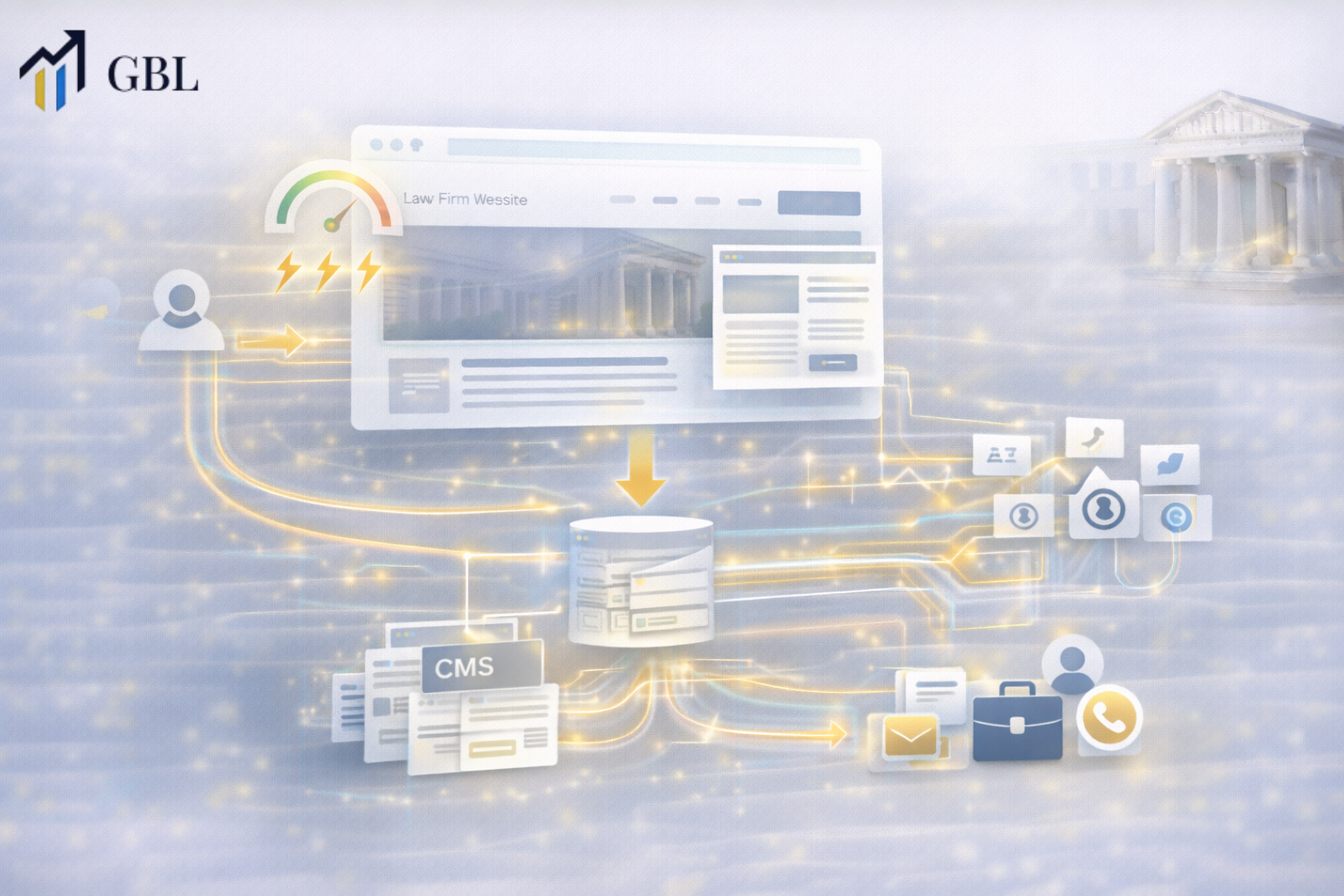
The most effective websites are built as systems, not individual parts. Performance, CMS, and integrations must work together to create a complete experience.
When these elements are aligned, your website becomes easier to manage, easier to scale, and more effective at generating leads.
Real Law Firm Example
A firm builds its website with all elements aligned and sees consistent growth. Another firm treats each part separately and struggles to improve performance.
Key Points
- Align all elements from the start
- Build with scalability in mind
- Focus on performance and structure
- Integrate systems early
This approach creates long-term success.
Most law firms never connect these elements properly.
The GBL Web Development System for Law Firms
At GBL, we approach web development as a complete system. Every website is designed to perform, scale, and convert.
We focus on structure, performance, and integration from the beginning.
Real Law Firm Example
A firm follows a structured development process and launches a high-performing website. Over time, results improve.
Key Points
- Performance-first development
- Flexible CMS selection
- Integration-driven systems
- Conversion-focused design
Explore our law firm website design services here to learn more about how this works.
This system ensures your website delivers real results.
Almost no legal firms ever use such a sophisticated approach.
What Results Law Firms Can Expect From Proper Web Development
When your website is built correctly, results become predictable. Your site performs better, ranks higher, and converts more visitors into clients.
The difference is not design, but execution.
Real Law Firm Example
A firm improves its website system and sees steady growth in traffic and leads.
Key Points
- Faster website performance
- Improved rankings
- Better user engagement
- Increased inquiries
- Consistent case flow
This is what proper development achieves.
Most law firms never reach this level because their approach is incomplete.
FAQs
- What is law firm web development?
It is the process of building a website that supports SEO, performance, and conversions. - Why is website speed important?
It affects both user experience and search rankings. - What CMS is best for law firms?
Flexible systems like WordPress are generally better. - What are website integrations?
They connect your site to tools like CRM and analytics. - Why do law firm websites fail?
They lack structure, performance, and proper planning.
Conclusion
Law Firm Web Development is not just about building a website. It is about creating a system that combines performance, flexibility, and functionality. When your website is built with the right structure, CMS, and integrations, it becomes a powerful tool for growth instead of just an online presence.
CTA
If your website is not performing the way it should, the issue may not be your marketing but the way your site was built. Many law firms invest in design without focusing on performance, scalability, and systems. At GBL, we build websites that are designed to rank, convert, and grow with your firm. Instead of relying on basic setups, you get a structured approach that turns your website into a reliable source of new cases. If you are serious about building a website that actually works, this is where it starts.