
Law Firm Website Design Analysis: How Lawyer Web Design Should Shape Your Site Architecture
TL;DR
- lawyer web design controls how your site is structured and ranked
- Most law firms lose cases due to poor website structure
- A clear architecture helps Google understand your services
- Strong internal linking improves SEO and conversions
- Focused service pages capture high-intent leads
- Poor design leads to confusion and lost clients
- A strategic website design creates consistent case flow
Introduction
Most law firms think they need more traffic to grow.
But the real problem is not traffic. It is structured.
Their lawyer web design is not built to guide users or help Google understand their services. Visitors land on the site, feel lost, and leave without taking action. At the same time, search engines struggle to rank pages because the structure is unclear.
A strong law firm website design should shape your entire site architecture. When done correctly, it creates a system that attracts the right visitors, guides them through your services, and converts them into real cases consistently.
How Lawyer Web Design Impacts Rankings and Case Flow
Law firms often believe that design is about visuals, branding, and layout. While those elements matter, they are not what drives results. The real impact of lawyer web design comes from how your pages are structured and how clearly your services are organized.
Search engines rely on structure to understand your website. If your design mixes multiple services into one page or fails to create clear connections between topics, your rankings suffer. At the same time, users struggle to find what they need, which reduces trust and leads to fewer inquiries.
Real Law Firm Example
One firm has a single “Personal Injury” page that mentions multiple services. Another firm builds separate pages for car accidents, truck accidents, and slip and fall cases, each supported by relevant content. The second firm consistently ranks higher and receives more qualified leads.
Key Points
- Structure helps Google understand your services
- Clear pages improve rankings
- Better organization improves user trust
- Focused content increases conversions
When design supports structure, your website becomes a system that drives both traffic and cases. Most law firms overlook this connection, which is why they struggle to grow online.
Most law firms get this wrong, and that is exactly where they lose high-value cases.
What a High-Converting Lawyer Website Structure Looks Like
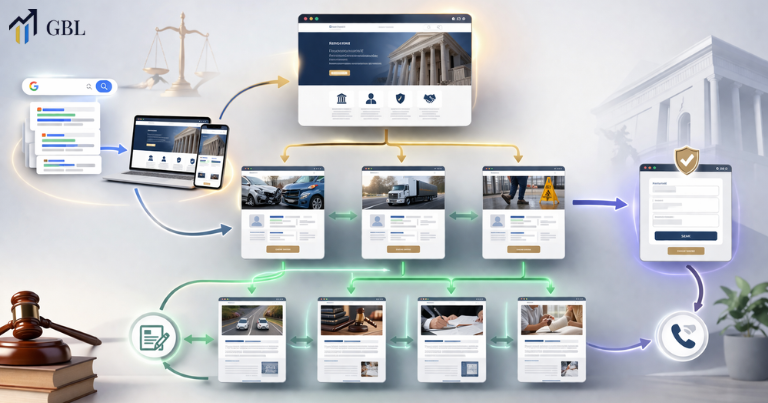
A high-performing website follows a clear structure that connects every page into a unified system. Instead of random pages, your website should guide users from general information to specific services and then toward taking action.
This structure also signals authority to search engines. When your pages are organized logically and supported by related content, Google sees your firm as an expert in that area.
Real Law Firm Example
A structured website looks like this:
Homepage
→ Personal Injury Lawyer
→ Car Accident Lawyer
→ Supporting blogs (rear-end accidents, whiplash, liability guides)
Each level supports the one above it and strengthens the entire website.
Key Points
- Homepage builds authority
- Service pages target specific intent
- Blogs support and strengthen rankings
- Internal links connect everything
This structure creates clarity for both users and search engines. Without it, your website remains weak and difficult to rank.
Most law firms never build this kind of structure, which is why they stay invisible in search results.
How to Structure Service Pages for Maximum SEO Impact
Service pages are the most important part of any law firm website. They are where high-intent users land and decide whether to contact you. If these pages are not structured properly, your entire strategy breaks down.
Each service page should focus on a single topic and answer the user’s question clearly. Combining multiple services into one page creates confusion and reduces your chances of ranking.
Real Law Firm Example
A firm using one general service page struggles to rank. Another firm creates dedicated pages for each service and supports them with relevant content. The second firm captures more search traffic and converts more visitors.
Key Points
- One service per page
- Clear keyword targeting
- Strong internal linking
- Clear call-to-action
This approach ensures that your website aligns with how people search for legal services. It also increases your ability to capture high-value leads.
Most law firms try to simplify their site too much, and that simplicity ends up costing them rankings and clients.
Website Design Mistakes That Cost Law Firms Clients
Many law firm websites fail because they are built without a clear strategy. These mistakes are not obvious at first, but they have a major impact on performance over time.
Firms often prioritize visual design and ignore structure, which leads to poor rankings and low conversions. Even a well-designed website can fail if it is not built with SEO and user flow in mind.
Real Law Firm Example
One firm uses a generic template with no clear structure. Another firm builds a custom site with defined service pages and internal linking. The second firm consistently outperforms the first in both rankings and leads.
Key Points
- Generic templates without strategy
- No clear page hierarchy
- Weak internal linking
- No conversion flow
- Mixing multiple services on one page
These issues create confusion for both users and search engines. Over time, they reduce your ability to compete.
This is where most law firms lose clients without realizing it.
How Internal Linking Strengthens Lawyer Web Design
Internal linking is a critical part of law firm web design that many firms ignore. It connects your pages and helps search engines understand how your content is related.
Without internal linking, your pages operate in isolation. With it, your website becomes a connected system that builds authority over time.
Real Law Firm Example
A blog about accident claims links naturally to a service page, guiding the user deeper into the website. This increases engagement and improves the chances of conversion.
If you want to see how this works in practice, explore our lawyer web design approach on our service page.
Key Points
- Connect blogs to service pages
- Link related topics together
- Improve user navigation
- Strengthen SEO performance
Internal linking helps both users and search engines move through your site more effectively. It also increases the value of every page you create.
Most law firms do not use internal linking strategically, which limits their growth potential.
The GBL Framework for Lawyer Website Design That Drives Cases
At GBL, website design is not treated as a visual project. It is treated as a system that drives growth. Every decision is made with rankings, user flow, and conversions in mind.
This approach ensures that your website works as a long-term asset instead of just an online presence.
Real Law Firm Example
A firm restructures its website using a system-based approach. Service pages are clearly defined, blogs support each topic, and internal linking connects everything. Within months, rankings improve and lead volume increases.
Key Points
- Structure-first approach
- SEO-driven page planning
- Conversion-focused design
- Content that supports services
- Strong internal linking system
This framework creates a predictable process for generating leads and cases. It removes guesswork and replaces it with a clear strategy.
Most law firms do not have this level of structure, which is why they struggle to see consistent results.
What Results Law Firms Can Expect From Proper Website Design
When your website is built correctly, results become predictable. Instead of relying on random traffic or paid ads, your site begins to generate consistent leads.
The key difference is alignment. When structure, content, and design work together, your website becomes a powerful growth tool.
Real Law Firm Example
A firm improves its structure and begins ranking for multiple service keywords instead of just one. This leads to increased traffic, more inquiries, and higher case volume.
Key Points
- Higher search rankings
- More qualified traffic
- Better engagement
- Increased inquiries
- More signed cases
This is the outcome of a well-designed system. It allows your firm to grow without constantly chasing new marketing tactics.
Most law firms never reach this stage because their website foundation is weak.
FAQs
What is the difference between lawyer web design and law firm website design?
Both refer to building websites for legal professionals, but the focus is on structure, SEO, and conversions rather than just visuals.
Why does website structure matter for law firms?
It helps search engines understand your services and makes it easier for users to navigate your site and take action.
How many service pages should a law firm have?
Each major service should have its own page, supported by additional content to build authority.
Can a poorly designed website hurt my rankings?
Yes, poor structure and navigation can reduce your ability to rank and convert visitors.
How long does it take to see results from website improvements?
With proper structure, improvements in rankings and leads can begin within a few months.
Conclusion
Most law firms believe their website needs better design, but the real issue is structure. Your lawyer web design controls how your site is organized, how search engines understand it, and how users move through it. When your structure is weak, your rankings stay low and your conversions suffer. When your design is built around clear architecture, focused service pages, and strong internal linking, your website becomes a system that consistently generates leads and cases.
CTA
If your website is not bringing in consistent cases, it is not a traffic problem. It is a structure problem. Many law firms lose valuable opportunities every month because their site is not designed to guide users or convert them. At GBL, we build websites with a clear system focused on rankings, user flow, and conversions. Instead of guessing what works, you get a proven approach that turns your website into a reliable source of new cases. If you are serious about growing your firm, this is the step that makes the difference.