
Fort Lauderdale Website Design for Law Firms: Timeline, Cost, and Vendor Selection
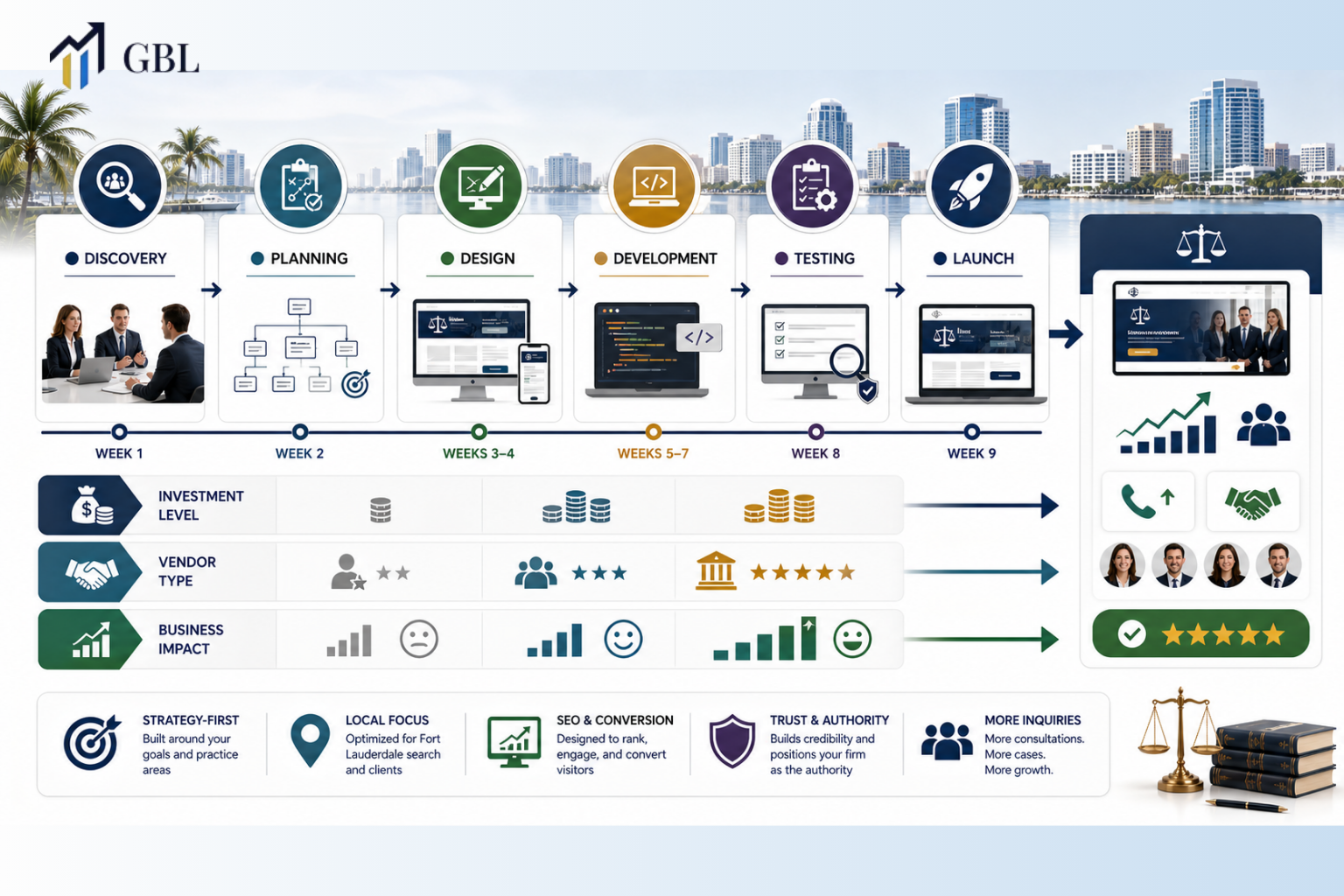
TL;DR
- Fort Lauderdale website design varies by strategy, not just price
- Timeline depends on planning and execution
- Cheap websites often cost more later
- Vendor choice impacts results and ROI
- Structured projects launch faster
- Strategy-driven sites generate more leads
- The right partner builds long-term growth
Introduction
Most law firms approach website design the wrong way.
They focus on cost and speed.
Then they end up rebuilding everything.
In Fort Lauderdale website design, the real question is not how fast or how cheap a website can be built. It is how well the website performs. A law firm website should not just exist. It should attract clients, build trust, and generate consistent inquiries. Without understanding how timeline, cost, and vendor selection work together, firms make decisions that limit growth.
At GBL, we see this pattern often. Firms invest in quick solutions without a long-term strategy, and the result is a website that looks acceptable but fails to rank or convert. A high-performing website is not built in isolation. It requires planning, structured development, and a clear focus on user behavior and search intent. When these elements are aligned from the start, the website becomes a system that consistently generates leads instead of something that needs to be fixed later.
How the Fort Lauderdale Market Changes Website Strategy for Law Firms
The Fort Lauderdale market is highly competitive and saturated. Many law firms are targeting the same practice areas, locations, and keywords. This creates a crowded environment where simply having a website is not enough. To stand out, your website must clearly communicate why your firm is different and why clients should choose you over others.
In Fort Lauderdale website design, the strategy must be built around local competition and user behavior. This means focusing on high-intent services that potential clients are actively searching for, such as specific case types and location-based queries. Your website should have dedicated service pages that clearly explain what you do and who you help. This improves both search visibility and user understanding.
Local optimization is also critical. Search engines prioritize relevance and proximity, so your content must reflect the Fort Lauderdale area. This includes using location-specific language, building local authority, and aligning your site structure with how users search in your market. Clear positioning helps users quickly recognize that your firm is the right choice for their needs.
Another important factor is differentiation. Many law firm websites look similar, which makes it harder for users to decide. A strong strategy highlights your unique strengths, experience, and approach. This helps your website stand out and builds trust faster.
Real Law Firm Example
One firm builds a generic website that looks similar to many others in the market. Their messaging is broad, and their structure does not focus on specific services or locations. As a result, they struggle to rank and attract qualified leads.
Another firm aligns its website with local search behavior. They create service-specific pages, optimize for Fort Lauderdale keywords, and clearly position their expertise. Their website becomes more visible, attracts the right audience, and generates more consistent inquiries.
Key Points
- High competition requires clear differentiation
- Local intent drives targeted traffic
- Service-focused pages improve rankings
- Strong positioning builds trust quickly
- Strategy determines visibility and conversions
This is where most firms fall behind. They focus on design without adapting to the market. When your website strategy is aligned with local competition and user intent, it becomes a powerful tool for attracting clients and generating consistent growth.
What a Realistic Website Timeline Looks Like (and Why It Often Breaks)
Most law firms expect a fast website launch. They assume the process is simple and can be completed quickly. However, in reality, timelines depend heavily on planning, clarity, and execution. A typical website project can take between 4 and 12 weeks, depending on the size of the site, the level of customization, and the strategy involved. When these factors are not properly managed, delays become common.
The main reason timelines break is a lack of clear direction at the start. When requirements are not fully defined, developers and designers have to adjust constantly. This leads to repeated revisions, which slow down progress and increase complexity. Another common issue is slow decision-making. When approvals are delayed or feedback is unclear, each phase takes longer than expected. Over time, these small delays add up and extend the overall timeline.
A structured process solves this problem. When each phase is clearly defined, from discovery and planning to design, development, and launch, the project moves more efficiently. Everyone involved understands their role, and decisions are made at the right time. This reduces confusion and keeps the project on track.
Real Law Firm Example
One firm starts its website without a clear plan. They continue to change content, design elements, and features throughout the process. Each change requires updates and testing, which delays the project by several weeks.
Another firm follows a structured plan from the beginning. They define their goals, approve content early, and stick to the agreed scope. As a result, their website is completed on time and performs as expected.
Key Points
- Planning defines the project timeline
- Frequent changes create delays and increase costs
- Clear phases improve workflow and execution
- Fast approvals keep progress steady
- Structure reduces uncertainty and risk
This is where projects slow down. Most law firms underestimate how much planning impacts timelines. When the process is clear and structured, website development becomes predictable, efficient, and easier to manage.
Why Website Cost Does Not Reflect Business Value
Cost is often misunderstood.
Price does not equal performance.
A low-cost website may look attractive but lack SEO, structure, and a conversion strategy. This limits long-term growth. A higher investment often includes strategy, planning, and optimization that drive results.
The real question is not cost. It is a return.
Real Law Firm Example
One firm chooses a cheap website and rebuilds later. Another invests in strategy and grows consistently.
Key Points
- Price does not equal value
- ROI matters more than cost
- Cheap options limit growth
- Strategy improves results
This is where firms lose money.
How Vendor Type Impacts Website Performance and Growth
Not all vendors are equal.
Each offers different outcomes.
Freelancers focus on basic design. Mid-level agencies provide better execution. Strategy-driven partners build systems that generate leads. The difference is not just quality. It is performance.
Choosing the right vendor determines how your website performs long-term.
Real Law Firm Example
One firm hires a freelancer and gets a basic site. Another hires a strategic partner and builds a lead system.
Key Points
- Freelancers offer low-cost solutions
- Agencies provide structure
- Strategy partners drive growth
- Vendor choice impacts ROI
This is where decisions matter.
How Poor Planning Leads to Delays and Higher Costs
Weak planning creates problems.
It increases complexity.
Without clear direction, projects require constant revisions. Each change adds time and cost. Over time, the project becomes inefficient and difficult to manage.
Planning reduces these risks and keeps projects on track.
Real Law Firm Example
One firm starts without a plan and delays everything. Another plans ahead and launches smoothly.
Key Points
- Frequent changes increase cost
- Poor planning delays projects
- Clarity improves efficiency
- Structure controls timelines
This is where costs increase.
How Website Structure Impacts Rankings and Case Flow
Structure defines performance.
It connects everything.
In website design Fort Lauderdale, structure determines how search engines understand your site and how users navigate it. Clear page hierarchy, internal linking, and service-focused content improve both rankings and conversions.
Without structure, your website becomes difficult to navigate and harder to rank.
Real Law Firm Example
One firm has disconnected pages. Another builds a structured system. The second firm performs better.
Key Points
- Structure improves SEO
- Internal links connect pages
- Clear hierarchy supports rankings
- Navigation improves user experience
This is where performance is built.
How to Choose the Right Fort Lauderdale Website Design Partner
Choosing a partner requires clarity.
Your goals define your choice.
If your goal is a basic website, a freelancer may work. If your goal is growth, you need a strategic partner. Outcomes, not just price, should be taken into consideration.
A strong partner understands both design and performance.
Real Law Firm Example
One firm chooses based on price and struggles. Another chooses based on strategy and grows.
Key Points
- Define goals clearly
- Focus on long-term ROI
- Look beyond design
- Choose performance over cost
This is where success is decided.
Frequently Asked Questions
- How long does website design take?
Typically 4–12 weeks, depending on scope. - What is the price of a website for a law firm?
Costs vary based on strategy and complexity. - Should I work with an agency or a freelancer?
Depends on your growth goals. - What is the biggest mistake?
Choosing based on cost instead of performance. - Does design impact SEO?
Yes, structure directly affects rankings.
Conclusion
Fort Lauderdale website design is not just about building a website. It is about building a system that supports growth. When timeline, cost, and vendor selection are aligned with strategy, your website becomes a reliable source of leads and long-term success.
CTA
If your website is not generating consistent inquiries, the issue is not just design. It is the lack of a structured system behind it. Most law firms focus on cost and speed, but ignore strategy and performance. At GBL, we build websites designed to rank, convert, and generate real case intake. Instead of just launching a site, you get a system built for growth. If you want your website to drive real results, this is where it starts.