
PPC for Attorneys: Why Most Campaigns Fail and How to Fix Yours
TL;DR
- Most ppc for attorneys campaigns fail due to poor strategy
- Clicks do not equal consultations
- Targeting must focus on intent
- Landing pages determine conversions
- Budget is wasted without structure
- Tracking is often incomplete
- Fixing PPC requires a full-funnel approach
Introduction
Many law firms invest in PPC.
But they do not see results.
They get clicks, impressions, and reports. But no consistent consultations. The issue is not the platform. It is the strategy behind it. Ppc for attorneys is not just about running ads. It is about building a system that turns search intent into signed cases.
At GBL, we see many law firms focus only on traffic and ad spend while ignoring the structure behind conversions. Campaigns may generate clicks, but without proper targeting, landing pages, messaging, and conversion flow, those clicks never turn into real clients. This is why many PPC campaigns feel expensive without producing meaningful growth.
Without a structured system, most campaigns fail.
Why Most PPC Campaigns Focus on Clicks Instead of Cases
Clicks are easy to measure, but they do not tell the full story. Cases are harder to track, which is why many law firms focus on the wrong metrics. In ppc for attorneys, campaigns are often optimized for traffic because it is simple to report. More clicks can make a campaign look successful, even when it is not generating real business results.
The problem is that clicks only represent the first step in the process. Getting someone to visit your website does not mean they will contact your firm. Without a clear path from the ad to a consultation, most users leave without taking action. This creates a gap between activity and outcomes, where campaigns appear busy but fail to produce meaningful results.
Another issue is misaligned intent. When campaigns focus on increasing clicks, they often attract users who are not ready to hire a lawyer. These visitors may be researching or comparing options, but they are not at the decision stage. This leads to wasted budget and low conversion rates.
The real goal of ppc for attorneys should be consultations, not traffic. Every part of the campaign, from keyword targeting to landing page design, should be built around guiding users toward contacting your firm. When strategy shifts from clicks to conversions, results become more predictable and valuable. To understand how a full-funnel strategy improves results across different ad platforms, explore our guide on Law Firm Paid Advertising.
Real Law Firm Example
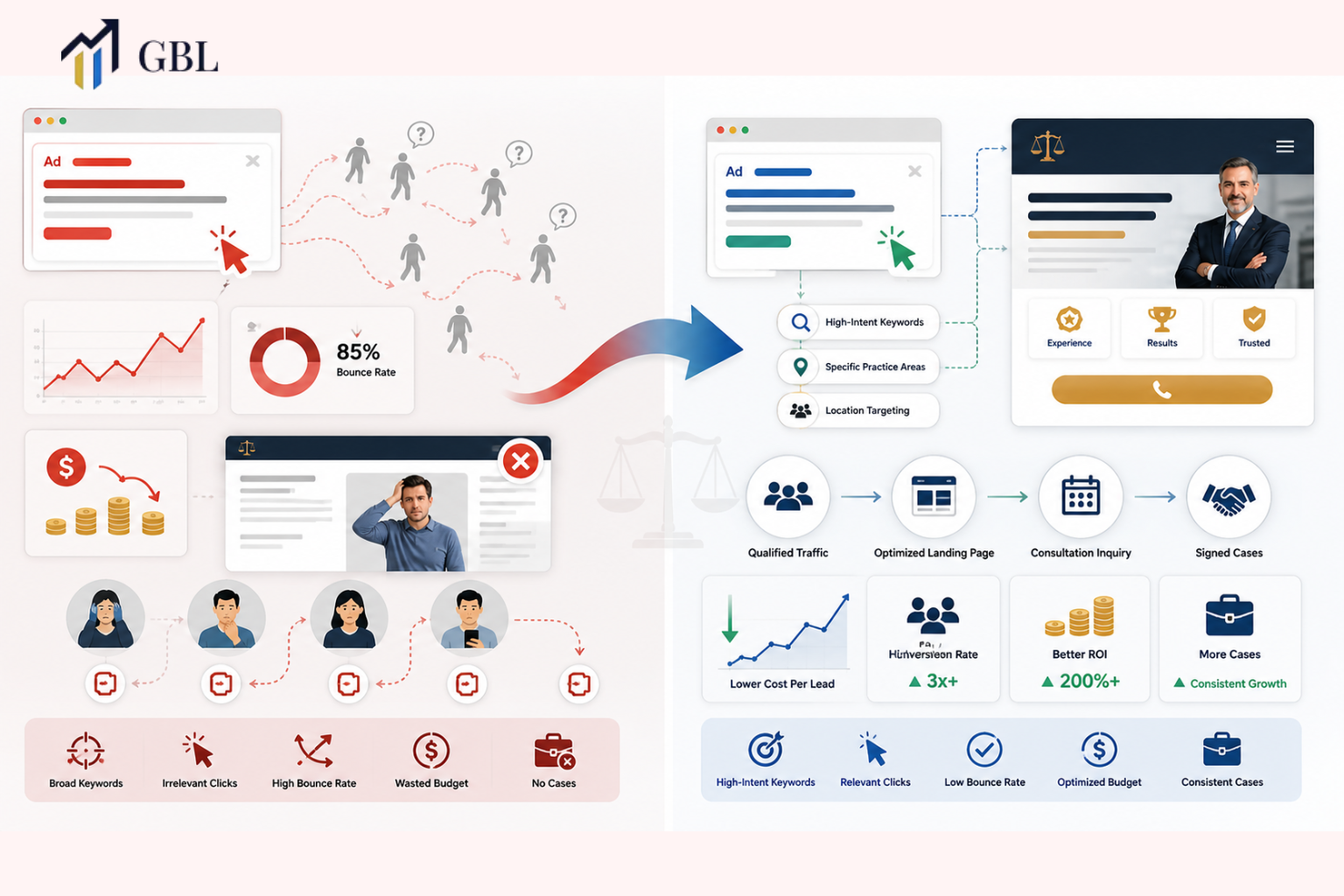
One firm runs campaigns focused on generating as many clicks as possible. Their ads attract a large number of visitors, but most leave without contacting the firm. Despite high traffic, they see little growth in consultations.
Another firm builds campaigns around conversions. They target high-intent keywords, use focused messaging, and direct users to optimized landing pages. As a result, they attract fewer visitors but generate more qualified leads and signed cases.
Key Points
- Clicks do not equal business results
- Traffic without intent leads to wasted budget
- Conversion-focused strategy improves outcomes
- High-intent targeting drives better leads
- Campaign structure determines success
This is where campaigns fail. Most law firms focus on visible metrics instead of meaningful outcomes. When your PPC strategy is built around conversions rather than clicks, your campaigns become more efficient, more predictable, and far more effective at generating real cases.
How Poor Keyword Targeting Wastes Budget Quickly
Keywords define your audience, and in ppc for attorneys, they determine who sees your ads and who clicks on them. When targeting is too broad or not aligned with user intent, your campaigns attract the wrong people. These users may click on your ads, but they are not ready to hire a lawyer. As a result, your budget is spent on traffic that does not convert into consultations or cases.
This is one of the most common reasons PPC campaigns fail. Broad keywords often bring in users who are researching general information, comparing options, or simply browsing. While this may increase click volume, it does not improve results. Each irrelevant click adds cost without contributing to your firm’s growth. Over time, this leads to inefficient campaigns where spending increases, but returns remain low.
Precise targeting solves this problem. By focusing on high-intent keywords, such as specific legal services and location-based searches, you attract users who are closer to making a decision. These users are more likely to contact your firm because their search reflects a clear need for legal help. This improves both conversion rates and overall ROI.
Another important factor is keyword structure. Grouping related terms and aligning them with specific ads and landing pages creates a more focused campaign. This improves relevance, reduces wasted spend, and increases performance. To understand how structured campaigns improve targeting and conversions, explore our guide on ppc for lawyers.
Real Law Firm Example
One firm targets general keywords like “lawyer” or “legal help.” Their ads receive many clicks, but most users are not ready to hire. The budget is quickly consumed without generating meaningful leads.
Another firm targets high-intent searches such as specific practice areas and location-based terms. Their ads reach users who are actively looking for legal services. As a result, they spend less on irrelevant clicks and generate more consultations.
Key Points
- Broad keywords attract low-intent traffic
- Irrelevant clicks waste the budget quickly
- High-intent keywords improve lead quality
- Precise targeting increases efficiency
- Structured campaigns reduce unnecessary spend
This is where budgets disappear. Most law firms focus on increasing visibility instead of improving targeting. When your keyword strategy is precise and aligned with user intent, your PPC campaigns become more efficient, more focused, and far more effective at generating real results.
Why Landing Pages Determine Whether Ads Convert
Ads bring users, but landing pages are what convert them. In ppc for attorneys, this is one of the most overlooked parts of the entire strategy. Many law firms invest heavily in ads but fail to see results because the page users land on does not match what they expected. When there is a disconnect between the ad and the page, users feel uncertain and leave without taking action.
A landing page should continue the message started in the ad. If someone clicks on an ad for a specific service, they should land on a page that clearly focuses on that exact service. This creates alignment and builds trust. When users immediately see that they are in the right place, they are more likely to stay, engage, and move toward contacting your firm.
Another important factor is clarity. A strong landing page removes distractions and focuses on a single goal, which is conversion. It uses simple messaging, clear headings, and visible calls-to-action to guide users step by step. Without this structure, users may feel overwhelmed or unsure about what to do next, which reduces conversions.
Trust also plays a key role. Elements such as reviews, case results, and credentials help users feel confident in their decision. These signals reinforce the message and reduce hesitation, making it easier for users to take action.
Real Law Firm Example
One firm sends all ad traffic to its homepage. The page includes general information and multiple services, which creates confusion. Users do not find what they are looking for quickly and leave without contacting the firm.
Another firm uses dedicated landing pages for each campaign. Each page is aligned with a specific service and clearly guides users toward booking a consultation. As a result, their conversion rate improves significantly, and they generate more leads from the same ad spend.
Key Points
- Landing pages directly impact conversion rates
- Alignment between ads and pages builds trust
- Clear messaging reduces confusion
- Focused structure guides user action
- Trust signals increase confidence
This is where conversions happen. Most law firms focus on getting clicks but ignore what happens after. When your landing pages are aligned, clear, and designed for action, your PPC campaigns become far more effective at turning traffic into real cases.
How Weak Conversion Tracking Hides Real Performance
What you measure defines decisions.
Incomplete tracking creates blind spots.
In ppc for attorneys, many firms track clicks but not consultations. This makes it difficult to understand what is working. Without proper tracking, campaigns cannot be optimized effectively.
Accurate tracking improves decision-making.
Real Law Firm Example
One firm tracks traffic only. Another tracks leads and calls. The second firm improves performance.
Key Points
- Tracking must include conversions
- Data improves strategy
- Blind spots reduce performance
- Measurement drives growth
This is where optimization begins.
Why Budget Allocation Without Strategy Fails
More budget does not fix problems.
It increases inefficiency.
In ppc for attorneys, firms often increase their budget when campaigns underperform. However, without a fixing strategy, this leads to more wasted spend. Budget should follow performance, not replace it.
Strategic allocation improves ROI.
Real Law Firm Example
One firm increases its budget and sees no results. Another optimizes first and scales later.
Key Points
- Budget without strategy fails
- Optimization improves efficiency
- Scaling requires structure
- ROI depends on planning
This is where money is lost.
How Full-Funnel PPC Strategy Improves Results
PPC is not just ads.
It is a system.
In ppc for attorneys, success depends on how each stage connects. Keywords attract users, ads create interest, landing pages convert, and follow-up closes cases. When these steps align, results improve.
A full-funnel approach creates consistency.
Real Law Firm Example
One firm runs isolated ads. Another builds a full funnel. The second firm grows steadily.
Key Points
- Funnel connects all stages
- Alignment improves results
- System drives consistency
- Strategy supports growth
This is where campaigns succeed.
Why Hiring a Specialized PPC Partner Matters
Legal PPC is complex.
Expertise makes the difference.
Most agencies apply generic PPC strategies. However, ppc for attorneys requires a deeper understanding of legal intent, competition, and conversion behavior. Without this, campaigns remain inefficient.
Specialized partners deliver better outcomes.
Real Law Firm Example
One firm hires a general agency and struggles. Another hires a specialized partner and improves ROI.
Key Points
- Legal PPC requires expertise
- Generic strategies fail
- Specialization improves results
- Experience drives performance
This is where expertise matters.
FAQs
- Why do PPC campaigns fail?
Due to poor strategy and targeting. - What matters most in PPC?
Conversions, not clicks. - Should I increase the budget?
Only after optimization. - Do landing pages matter?
Yes, they drive conversions. - Should I hire an agency?
Yes, if they specialize in legal PPC.
Conclusion
PPC for attorneys is not about running ads. It is about building a system that turns intent into action. When targeting, structure, and conversion flow are aligned, PPC becomes a predictable source of growth.
CTA
If your PPC campaigns are not generating consistent consultations, the issue is not the platform. It is the strategy behind it. Most law firms waste budget on clicks that do not convert. At GBL, we build full-funnel PPC systems designed to attract high-intent clients and turn them into real cases. Instead of guessing, you get a proven system focused on results. If you want PPC that drives real growth, this is where it starts.