
Law Firm Website Examples: Anatomy of the Pages That Rank and Convert in 2026
TL;DR
- Law firm website examples are useful only if you understand why they work
- High-performing sites follow a clear structure, not just design trends
- SEO, content, and layout work together to drive results
- Each page has a specific role in the user journey
- Strong websites guide users from search to contact
- Design supports conversion, not just appearance
- The right structure turns traffic into cases
Introduction
Many law firms search for examples of law firm websites to get ideas for their own sites.
They look at designs, layouts, and visuals, and try to replicate what they see. But after launching their website, they often see little improvement in rankings or leads.
The problem is not the examples. It is how they are interpreted.
Law firm website examples are only useful when you understand the structure behind them. High-performing websites are not built around design alone. They are built as systems that support SEO, guide users, and convert visitors into real clients.
How High-Performing Law Firm Websites Are Structured for Rankings and Conversions
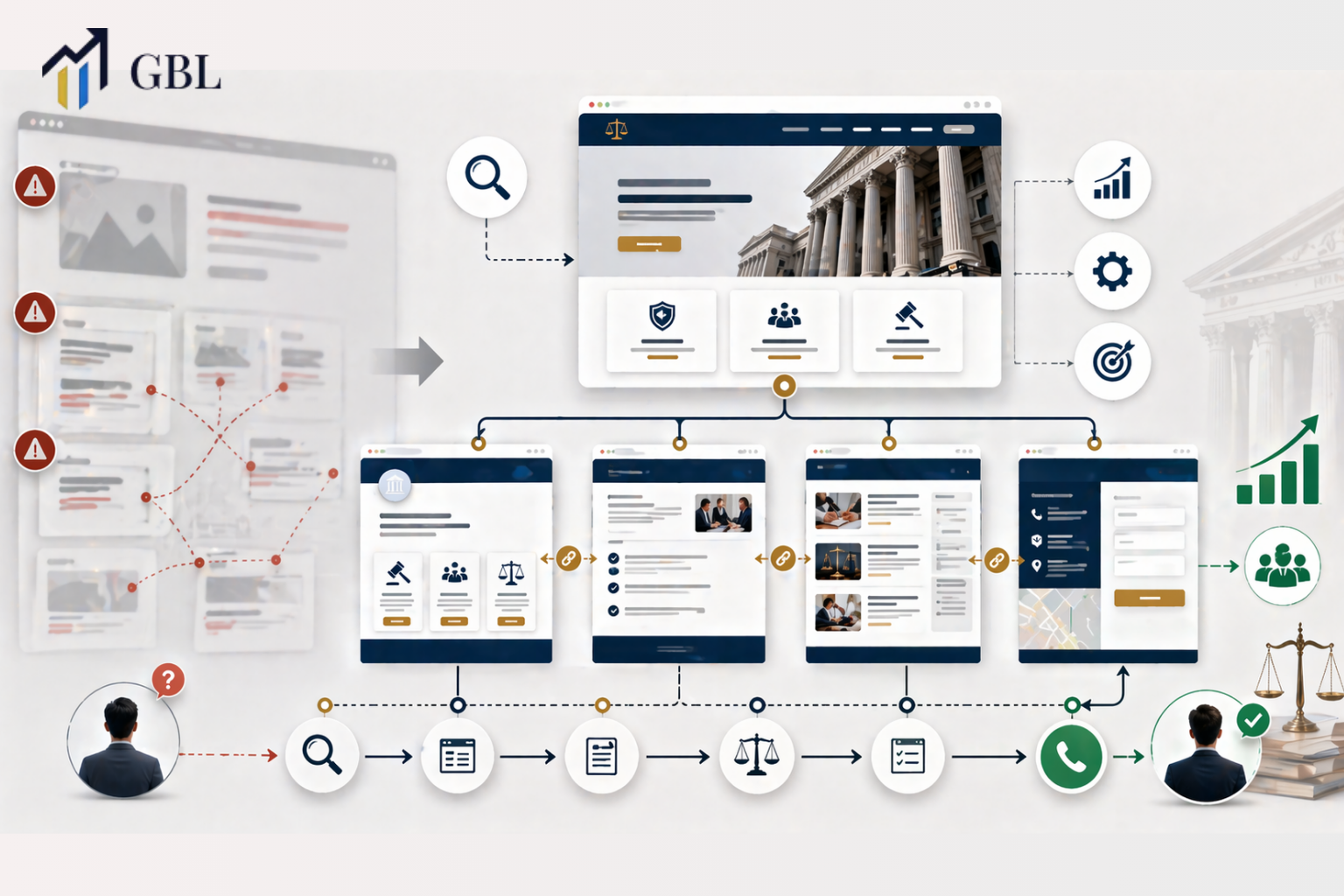
The best law firm website examples are built with structure first, not design. Every page has a clear purpose, and every section supports both search engines and users.
Search engines need clarity to rank your pages. Users need clarity to take action.
Real Law Firm Example
One firm builds a visually appealing website with no clear structure. Another builds a structured system with service pages and supporting content. The second firm ranks higher and generates more leads.
Key Points
- Clear page hierarchy improves SEO
- Each service has its own page
- Content supports rankings
- Structure guides users
Structure is what drives performance.
Most law firms focus on design and ignore this foundation.
How High-Performing Law Firm Websites Are Structured for Rankings and Conversions
The best law firm website examples are built with structure first, not design. Every page has a clear purpose, and every section is planned to support both search engines and users. Instead of focusing only on how the website looks, high-performing sites focus on how the website works. This includes how pages are organized, how information is presented, and how users are guided from one step to the next.
Search engines need clarity to understand what your website is about. They analyze how your pages are connected, what topics you cover, and how well your content matches user intent. If your website is disorganized or lacks a clear structure, it becomes harder for search engines to rank your pages. At the same time, users also need clarity. When someone lands on your website, they should immediately understand what you offer and where to go next. If they feel confused or lost, they will leave without taking action.
A strong structure creates a smooth path. It helps users move from search to service pages, then toward contacting your firm. This is what turns a website into a lead-generating system rather than just presenting information.
Real Law Firm Example
One firm builds a visually appealing website with no clear structure. The design looks modern, but services are grouped, navigation is unclear, and there is no supporting content. As a result, the site struggles to rank and does not generate consistent leads.
Another firm builds a structured system with separate service pages, supporting blogs, and clear internal links. Each page targets a specific topic, and users are guided step by step. Over time, this website ranks higher, keeps users engaged, and generates more inquiries.
Key Points
- Clear page hierarchy improves SEO and rankings
- Each service should have its own focused page
- Supporting content strengthens authority
- Internal links connect related pages
- Structure guides users toward taking action
Structure is what drives performance. It connects SEO, content, and user experience into one system that works together.
Most law firms focus on design because it is visible and easy to judge. But without a strong structure behind it, even the best-looking website will struggle to perform. The firms that invest in structure are the ones that rank higher, attract better traffic, and convert more visitors into real clients.
How Service Pages Drive SEO Performance and Lead Generation
Service pages are the core of law firm web development. They target specific keywords and match user intent.
Each service page should focus on one legal service and guide users toward contact.
Real Law Firm Example
A firm uses one general page for all services. Another creates separate pages for each service. The second firm ranks higher and generates more leads.
Key Points
- One service per page
- Target specific keywords
- Provide detailed information
- Include clear calls-to-action
Service pages are where rankings and conversions happen.
Most law firms do not build enough of them.
How Supporting Content Builds Authority Around Your Services
High-performing lawyer website development includes content that supports service pages. Blogs answer related questions and strengthen authority.
This helps search engines understand your expertise.
Real Law Firm Example
A firm has only service pages. Another adds blogs that support each service. The second firm builds authority and ranks higher.
Key Points
- Blogs support service pages
- Content answers user questions
- Internal links connect pages
- Authority improves rankings
Content turns your website into a system.
Most law firms create content without structure.
How Internal Linking Connects Pages and Improves Rankings
Internal linking is a key part of strong law firm website examples. It connects pages and helps both users and search engines navigate your site.
This improves SEO and user experience.
Real Law Firm Example
A firm creates pages but does not link them. Another connects all pages with internal links. The second firm performs better.
Key Points
- Links connect related pages
- Improves navigation
- Supports SEO
- Strengthens authority
Internal linking builds structure.
Most law firms ignore this simple step.
The Role of Conversion Design in Turning Traffic into Cases
Design in lawyer web development should focus on conversion, not just appearance. Every element should guide users toward taking action.
This includes layout, messaging, and calls-to-action.
Real Law Firm Example
A firm focuses on visuals but has no clear CTAs. Another uses design to guide users. The second firm generates more leads.
Key Points
- Design supports user flow
- Clear CTAs drive action
- Layout affects engagement
- Messaging builds trust
Conversion design turns visitors into clients.
Most law firms design for looks, not results.
The GBL Framework Behind High-Performing Law Firm Website Examples
At GBL, we build websites as systems. Every page, section, and element is designed to support rankings and conversions.
This ensures that your website delivers real results.
Real Law Firm Example
A firm follows a structured approach and sees consistent growth in traffic and leads.
Key Points
- Strategy-first development
- SEO integration
- Conversion focus
- Scalable structure
If you want to see how this works, explore our law firm website examples approach here.
This is what separates high-performing sites.
Most law firms never build this level of system.
What Results Law Firms Can Expect From the Right Website Structure
When your website is built correctly, it becomes a consistent source of growth. It attracts traffic, builds trust, and generates leads.
The difference is not design. It is structured.
Real Law Firm Example
A firm improves its structure and sees steady increases in rankings and inquiries.
Key Points
- Higher rankings
- Better traffic quality
- More conversions
- Increased leads
- Consistent case flow
This is what the right structure delivers.
Most law firms never reach this level because they focus on surface-level design.
FAQs
- What are the best law firm website examples?
The best examples are those that combine SEO, structure, and conversion. - Why do most law firm websites fail?
They lack structure and strategy. - Are design and SEO equally important?
Yes, but structure connects both. - How many service pages should a law firm have?
Each service should have its own page. - What improves website conversions?
Clear messaging and strong calls-to-action.
Conclusion
Law firm website examples are useful only when you understand what makes them work. The best websites are not just well-designed. They are structured to support SEO, guide users, and convert traffic into real clients. When you focus on structure instead of appearance, your website becomes a powerful growth tool.
CTA
If you are reviewing law firm website examples to improve your own site, the key is not copying design but understanding the system behind it. Most law firms build websites that look good but fail to perform because they are missing structure, SEO planning, and conversion strategy. At GBL, we build websites designed to rank, attract the right clients, and turn traffic into consistent case inquiries. Instead of guessing what works, you get a proven system that drives real results. If you want your website actually to generate cases, this is where it starts.