
Law Firm Website Templates: When a Template Is Good Enough and When You Need Custom
TL;DR
- A law firm website template can work at an early stage
- Templates limit SEO and conversion potential
- Custom websites support long-term growth
- Cheap solutions often cost more later
- Structure matters more than design
- Strategy determines performance
- The right choice depends on your goals
Introduction
Most law firms start with one goal.
Get a website live quickly.
They chose a law firm website template because it feels fast, simple, and affordable. But over time, they realize something is missing. The website looks fine, but it does not rank well or generate consistent leads. The issue is not the design itself. It comes down to a lack of strategy.
At GBL, we see this pattern repeatedly. Law firms focus on launching fast instead of building a system that attracts and converts clients. Choosing between a template and a custom website is not just a design decision. It is a growth decision.
When a Law Firm Website Template Is Good Enough
Templates can work in certain situations, but only at specific stages of a law firm’s growth. A law firm website template is most useful when your main goal is to get online quickly and establish a basic presence. For new firms, solo practitioners, or firms testing a new market, this approach can provide a fast and affordable starting point without requiring a large investment.
At this stage, the focus is not on scaling or dominating search results. It is on visibility. A template allows you to present your services, share contact information, and begin building awareness. It gives you a foundation that can be used to introduce your firm to potential clients and start creating a digital footprint.
However, templates are designed for general use, not for specific law firms. They follow a standard layout that may not fully reflect your services, audience needs, or local competition. This means that while your website may look professional, it is not optimized to stand out or perform at a high level. As your firm begins to grow, these limitations become more noticeable. You may find it harder to rank in search results, differentiate your brand, or convert visitors into clients.
Real Law Firm Example
One firm uses a template to launch quickly and establish an online presence. They are able to get their services online and start receiving some initial traffic. However, as they try to expand, they notice that their website does not generate consistent leads.
Another firm starts with a template but quickly recognizes its limitations. They transition to a more structured and strategic approach as their goals evolve. This allows them to improve visibility, attract higher-quality traffic, and generate more inquiries over time.
Key Points
- Templates support a quick and affordable launch
- Useful for early-stage visibility
- Limited customization restricts growth
- Generic structure reduces differentiation
- Not built for long-term performance
This is where templates make sense. They are a starting point, not a final solution. Most law firms stay on templates longer than they should, which limits their ability to grow. When your goals shift from simply being online to generating consistent cases, your website needs to evolve beyond a basic template.
Why Templates Limit SEO and Case Generation
Templates often look clean and professional on the surface, which is why many law firms choose them in the beginning. However, the real limitation of a law firm website template appears when performance becomes the goal. While the design may look acceptable, the underlying structure is usually generic and not built to support strong SEO or consistent case generation.
Most templates are designed to work for a wide range of industries, not specifically for law firms. This means they lack the depth needed to target specific services, locations, and search intent. Pages are often broad and not optimized around how potential clients actually search for legal help. As a result, search engines struggle to understand what your website is about, which reduces your ability to rank for high-value keywords.
Another key issue is content alignment. Templates do not guide you in creating structured, intent-driven content. Without dedicated service pages and clear topic clusters, your website attracts general traffic instead of high-intent users who are ready to hire a lawyer. Even if visitors land on your site, the lack of clear flow and direction makes it harder to convert them into leads.
User experience is also affected. Generic layouts do not always guide users toward taking action. This creates friction and increases bounce rates, which further impacts performance.
Real Law Firm Example
One firm relies on a template and struggles to rank for competitive keywords. Their content is broad, and their structure does not clearly define their services. As a result, traffic remains low and inconsistent.
Another firm builds structured pages focused on specific services and user intent. Their website clearly communicates what they offer and guides users toward contacting the firm. Over time, they rank higher, attract better traffic, and generate more leads.
Key Points
- Generic structure limits SEO performance
- Lack of intent-focused pages reduces visibility
- Weak content alignment attracts low-value traffic
- Poor UX reduces conversions
- Templates restrict long-term growth
This is where firms lose opportunities. A template may help you get online, but it does not create a system for growth. Without a structure designed for SEO and conversions, your website becomes a passive asset instead of a tool that drives consistent case intake.
When Custom Website Design Becomes Necessary
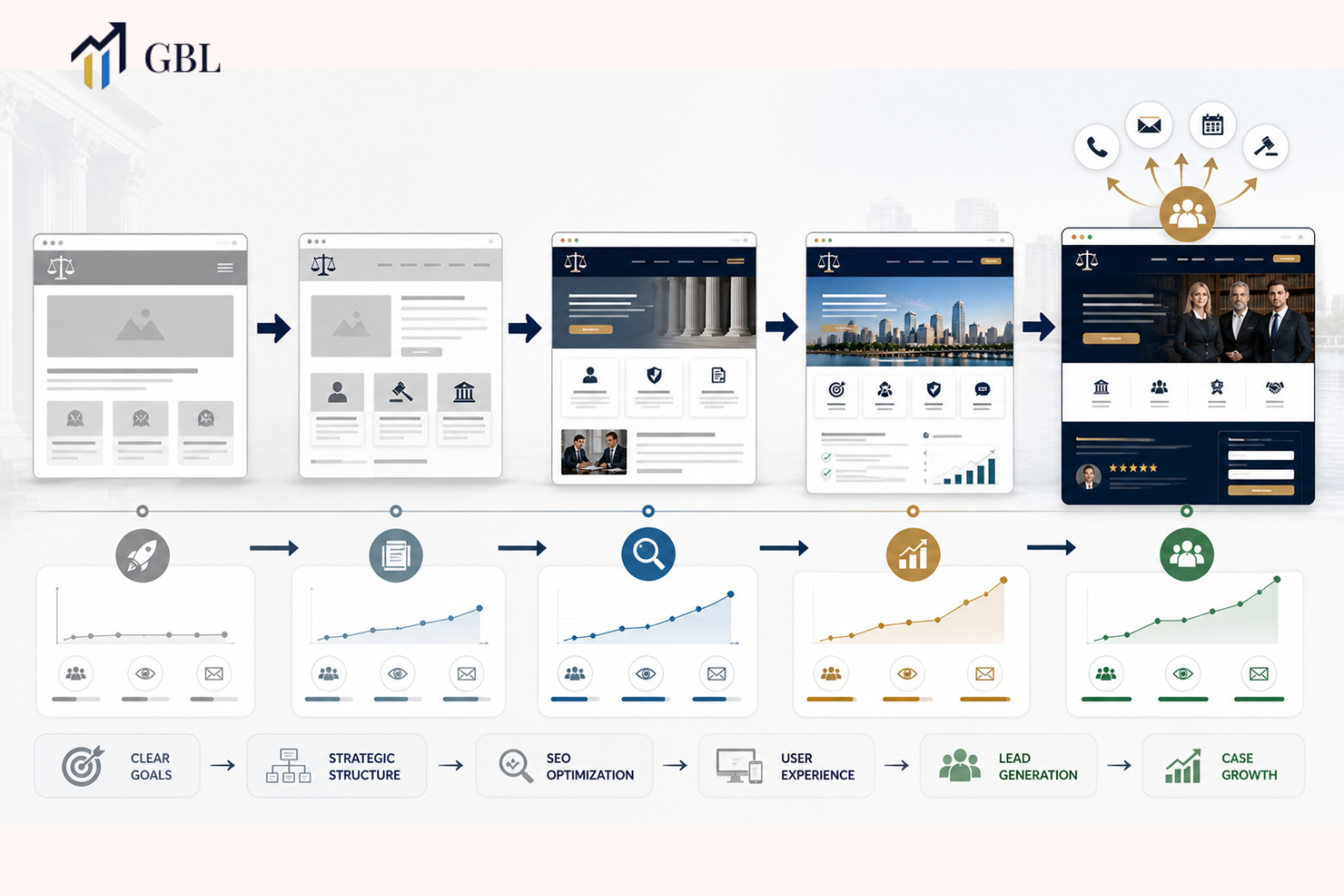
Growth requires flexibility, and this is where templates begin to fall short. A law firm website template may help you get started, but it is not built to support long-term expansion. As your firm grows, your website must evolve with it. A simple arrangement is not enough. You need a system that can handle increasing traffic, support multiple services, and guide users toward taking action.
This is where custom website design becomes necessary. A custom site is built specifically around your firm’s goals, services, and target audience. Instead of using a generic structure, it allows you to create dedicated service pages that target high-intent searches. It also enables better content organization, making it easier for search engines to understand your expertise and for users to find what they need.
Another key advantage is conversion flow. A custom website is designed to guide visitors step by step, from landing on your site to contacting your firm. This includes clear messaging, strong calls to action, and a layout that reduces friction. These elements work together to improve user experience and increase the chances of turning visitors into clients.
Real Law Firm Example
One firm continues using a template even as they grow. Over time, they struggle to add new services, improve rankings, and generate consistent leads. Eventually, they are forced to rebuild their website, which costs both time and money.
Another firm invests in a custom website early in its growth stage. Their site is built with a clear structure, targeted content, and a strong conversion strategy. As their firm expands, their website supports that growth, helping them attract more qualified traffic and generate steady inquiries.
Key Points
- Custom design supports long-term growth
- Flexible structure improves SEO performance
- Dedicated pages target high-intent searches
- Better UX increases conversions
- Strategy-driven design delivers results
This is where real growth begins. Most law firms delay this step because templates feel sufficient at first. However, as competition increases and goals expand, a custom website becomes essential. When your site is built around strategy rather than convenience, it becomes a powerful tool that drives consistent case intake and long-term success.
How Website Structure Impacts Rankings and Conversions
Structure defines performance.
It connects everything.
Whether you use a template or a custom design, structure is critical. A well-structured site organizes content clearly, connects pages through internal links, and guides users toward action.
Poor structure leads to confusion and weak results.
Real Law Firm Example
One firm has disorganized pages. Another uses structured silos. The second firm ranks higher.
Key Points
- Structure improves SEO
- Internal linking supports authority
- Clear navigation improves UX
- Organized content drives conversions
This is where performance is built.
Cost vs ROI: Why Cheap Templates Often Cost More
Cheap solutions seem attractive.
But they have hidden costs.
A law firm website template may save money upfront, but it often leads to missed opportunities. If your website does not generate leads, you lose potential revenue. Over time, this becomes more expensive than investing in a better solution.
ROI matters more than cost.
Real Law Firm Example
One firm saves money with a template but rebuilds later. Another invests early and grows consistently.
Key Points
- Low cost limits performance
- Poor results reduce ROI
- Rebuilding increases expenses
- Investment drives growth
This is where firms lose money.
How Different Practice Areas Require Different Website Strategies
Not all law firms are the same.
Strategy must adapt.
A personal injury lawyer website design requires strong trust signals and urgency. A family law attorney website design needs emotional messaging and clarity. Templates cannot fully support these differences.
Custom strategies improve results.
Real Law Firm Example
One firm uses the same template for all services. Another customized strategy. The second firm performs better.
Key Points
- Practice areas need unique strategies
- Templates limit customization
- Messaging must align with the audience
- Strategy improves engagement
This is where differentiation happens.
How to Decide Between Template and Custom Design
The right choice depends on your goals.
Not your budget alone.
If your goal is a basic presence, a template may work. If your goal is growth, you need a custom solution. The decision should be based on long-term outcomes, not short-term savings.
Real Law Firm Example
One firm chooses based on cost and struggles. Another chooses based on strategy and grows.
Key Points
- Define your goals clearly
- Focus on long-term ROI
- Look beyond design
- Choose performance
This is where decisions matter.
Frequently Asked Questions
- Are templates good for law firms?
Yes, for basic needs. - Do templates affect SEO?
Yes, they limit performance. - When should I upgrade?
When you want growth. - Are custom sites worth it?
Yes, for long-term ROI. - What is the biggest mistake?
Choosing based on cost.
Conclusion
A law firm website template can be a starting point, but it is not a long-term solution for growth. When your goal is to generate consistent leads and build authority, you need a website designed with strategy and performance in mind. The right choice depends on where your firm is today and where you want it to go.
CTA
If your website is not generating consistent inquiries, the problem is not just design. It is the lack of structure and strategy behind it. Most law firms rely on templates that limit growth and performance. At GBL, we build websites designed to rank, convert, and generate real case intake. Instead of settling for a basic solution, you get a system built for long-term success. If you want your website to drive real results, this is where it starts.